Vegetables
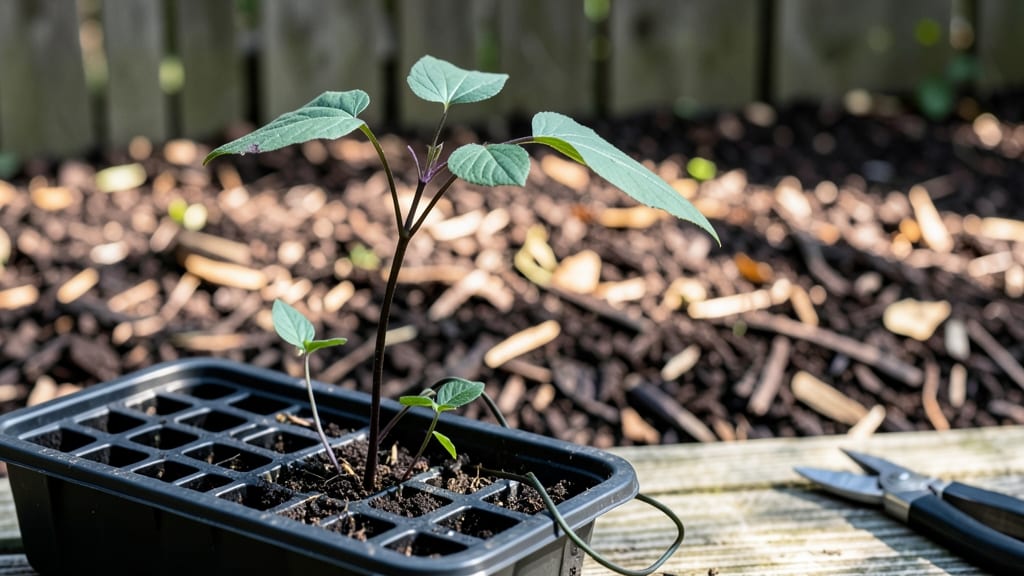
Identifying black bindweed seedlings starts with their distinctive arrowhead-shaped leaves, glossy dark green color, and aggressive vine growth habit. Unlike morning glory, these seedlings never produce showy white or purple blooms.
These young plants grow rapidly, sending out long tendrils that cling to soil or climb vertical surfaces within weeks. 🌱 The key difference from morning glory lies in their leaf structure—bindweed's pointed lobes create a sharper, more angular outline, while morning glory leaves are smoother and heart-shaped.
I've found that examining the leaf veins under natural light reveals bindweed's characteristic parallel venation pattern, which helps confirm identification in early stages.
Black bindweed thrives in disturbed soils, often appearing after garden cultivation or along fence lines where morning glory might not take hold.
The absence of flowers in seedlings is your first clue—morning glory produces its signature blooms by mid-summer, while bindweed remains flowerless until late summer or fall, if at all in some varieties.
💡 In This Article
- Distinguishing Black Bindweed Seedling Features
- Early Detection Tips for Black Bindweed in Gardens
Distinguishing black bindweed seedling features
The most reliable way to identify black bindweed seedlings is by examining their leaf morphology under magnification. These young plants develop sagittate (arrowhead-shaped) leaves with three to five distinct lobes, where the terminal lobe extends into a sharp point.
This contrasts sharply with morning glory's cordate (heart-shaped) leaves, which have smooth, rounded edges. The leaf base of bindweed often appears slightly asymmetrical, with one side slightly longer than the other—a trait that becomes more pronounced as the plant matures.
Black bindweed stems exhibit another key difference: they're glossy and smooth to the touch, often with a slight waxy coating that makes them appear almost silvery under certain lighting.
Morning glory stems, by comparison, tend to be hairy or downy, especially along the veins. 🌿 The vine growth habit is equally distinctive—bindweed produces twining stems that can reach 10-15 feet in a single season, while morning glory's vines typically max out around 6-8 feet unless given extreme support.
The root system is another game-changer: bindweed develops a deep, fibrous root network capable of penetrating 6-12 inches into soil, making it far more invasive than morning glory's shallower roots.
Virginia creeper offers yet another point of comparison, as its seedlings often get confused with bindweed. The key difference lies in the leaf arrangement: Virginia creeper has palmate compound leaves (5 leaflets arranged like fingers on a hand), while bindweed maintains its simple arrowhead shape throughout all growth stages.
Additionally, Virginia creeper produces red berries in fall, whereas black bindweed remains flowerless until late summer or may produce small, white or greenish flowers that lack the showy appearance of morning glory's blooms.
What most gardeners overlook is the growth rate difference. Black bindweed seedlings can grow 1-2 inches per day under optimal conditions, while morning glory typically grows 3-6 inches per week.
This rapid growth allows bindweed to quickly establish dominance in garden beds, often smothering other plants within 4-6 weeks of germination. The glossy leaf surface also helps bindweed conserve moisture better than its competitors, giving it an edge in dry conditions.
For accurate identification, examine these three critical features together: leaf shape (arrowhead vs heart), stem texture (smooth vs hairy), and growth rate (rapid vs moderate).
I've found that using a 10x hand lens to inspect leaf venation patterns—bindweed's parallel veins versus morning glory's pinnate pattern—eliminates nearly all confusion in early stages. The absence of flowers in seedlings is your first major clue, as morning glory's distinctive blooms never appear in the juvenile phase.
Here's a quick visual comparison you can use in the field:
- Black Bindweed: Arrowhead leaves, glossy stems, 1-2" daily growth, no early flowers
- Morning Glory: Heart-shaped leaves, hairy stems, 3-6" weekly growth, white/purple flowers later
- Virginia Creeper: Compound leaves (5 leaflets), red berries in fall, slower growth rate
The key takeaway is that black bindweed's aggressive growth habit and distinctive leaf architecture make it identifiable even before flowering occurs. This early detection capability is crucial for gardeners, as removing seedlings before they establish roots gives you a 90%+ success rate in eradication. 💫