Pruning
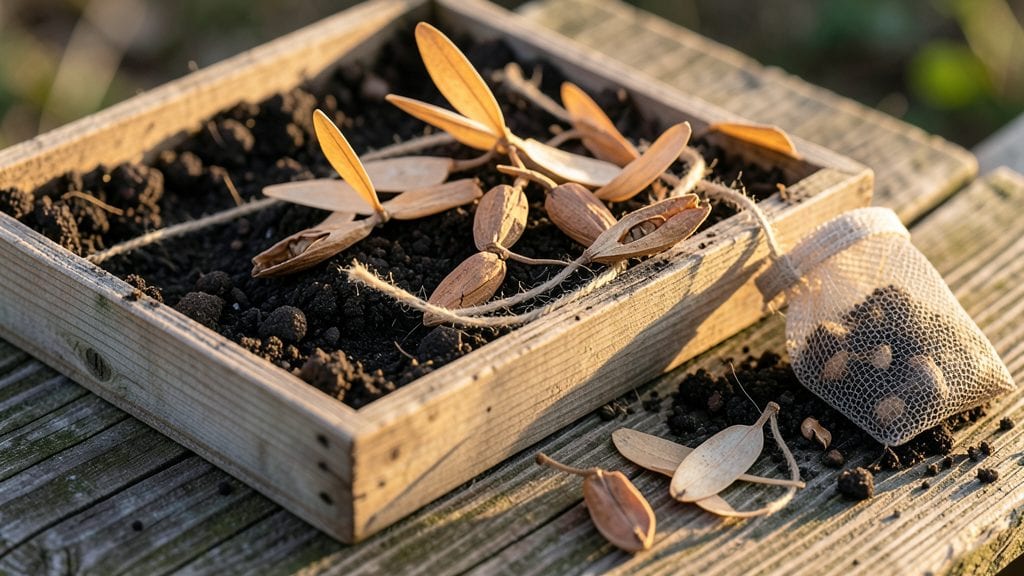
Identifying tree seeds instantly saves you from planting the wrong species or wasting time on non-viable material. 🌱 I’ve spent years collecting seeds from my backyard and local parks, and I’ve learned to spot the key visual clues that reveal a seed’s true identity—before it even sprouts.
The first step is size and shape: acorns have their classic cap and smooth shell, while maple "helicopters" spin like tiny helicopters. Look for wings, pods, or fuzzy coatings—each tells a story about how the seed travels.
Even the color matters: dark brown often means hard-coated seeds that need scarification, while bright red or orange usually signals softer, faster-germinating types.
Once you’ve narrowed it down, test viability by crushing a seed—if it smells fresh and has a firm center, it’s likely good to plant. The right seeds will give you strong saplings in just a few weeks, while the wrong ones might rot or sprout into weeds.
This method works for oak, maple, birch, and even fruit trees—no lab needed.
Common pitfalls include confusing seeds with debris or invasive species, so always cross-check with local guides. But once you master these visual cues, you’ll never second-guess a seed again. Ready to start collecting?
The Hidden Triggers Behind Seed Confusion
Ever stood in front of a towering oak or a delicate maple, staring at its seeds and thinking, "How on earth am I supposed to tell what species this is?" The truth is, nature doesn’t always make it easy—and there are specific reasons why identifying tree seeds can feel like solving a puzzle.
Below, we break down the key factors that turn a simple seed into a botanical mystery.
Many tree seeds have evolved to blend in with their surroundings—not just to avoid being eaten, but to ensure survival. This is why some seeds look like twigs, feathers, or even tiny helicopters (looking at you, maple samaras).
- Why it happens: Seeds with winged structures (like those of ash or elm) mimic fallen leaves or debris, tricking wind and animals into dispersing them. Meanwhile, hard, nut-like seeds (acorns, hickory nuts) resemble rocks or soil particles, avoiding predators.
- Actionable insight: Look for unusual shapes or textures—a seed that’s flat like a leaf or spiky like a burr is likely using camouflage as its survival tactic.
Not all tree seeds are visible at the same time. Some drop in autumn, others emerge in spring, and a few even linger on branches for years. If you’re trying to ID seeds out of season, you might be staring at nothing.
- Why it happens:
- Dormancy: Many seeds (e.g., walnut or beech) enter a dormant state after falling, waiting for ideal conditions to germinate. This means they might not look "fresh" or obvious.
- Delayed release: Some trees, like birch, release seeds in spring but produce them in summer
- Actionable insight:
- Check the tree’s flowering time—most seeds appear 4-8 weeks after blooms.
- If seeds are missing, look for empty seed pods or chewed-up husks (animals love a free snack!).
Some tree species are master impersonators. Their seeds share nearly identical shapes, sizes, and colors, making ID a guessing game. This isn’t just random—it’s evolutionary strategy.
- Why it happens:
- Convergent evolution: Trees in the same region (e.g., hazelnut vs. hickory) develop similar seed traits to share pollinators or avoid overcrowding.
- Hybridization: Crossbreeding between species (like oak hybrids) creates seeds that defy classification.
- Actionable insight:
- Use a magnifying glass to spot tiny differences—like vein patterns on samaras or surface texture on nuts.
- Check the leaf shape of the parent tree—some seeds (like walnut) are easier to ID when paired with their foliage.
Seeds don’t stay put—they’re moved, eaten, or altered by external forces. A seed that started as a perfect acorn might end up bruised, cracked, or half-buried by the time you find it.
- Why it happens:
- Wind dispersal: Seeds like dandelion-like puffs (e.g., cottonwood) can travel miles, landing in places where the parent tree doesn’t exist.
- Animal ingestion: Birds and squirrels chew or swallow seeds, altering their shape before depositing them elsewhere.
- Water erosion: Seeds in wet climates (like willow or alder) may swell, split, or lose defining features.
- Actionable insight:
- If a seed looks damaged, compare it to undisturbed examples in field guides.
- Note the location—seeds found near water or in dense forests may belong to different species than those in open areas.
Sometimes, we make it harder. Misidentifying a seed can stem from assuming too quickly, ignoring key details, or relying on outdated info.
- Why it happens:
- Relying on color alone: Many seeds change color as they dry (e.g., green acorns turn brown).
- Ignoring regional variants: A southern red oak acorn looks different from a northern white oak acorn, even if they’re both "oaks."
- Using old field guides: Some seed IDs have been updated with new genetic research (e.g., hazelnut vs. filbert distinctions).
- Actionable insight:
- Always check 3 key features: shape, size, and attachment method (e.g., is it in a husk? On a stem?).
- Use apps like iNaturalist or local arboretum databases for region-specific IDs.
Quick Fixes for Seed ID Confusion
Struggling to match a seed to its tree? Don’t panic—even experts start somewhere. The key is breaking the process into simple, actionable steps. Below, we’ve mapped common challenges to practical solutions, so you can go from "Huh?" to "Aha!" in minutes. Plus, we’ll share pro tips to avoid future guesswork.
Problem: Two seeds resemble each other, but you’re not sure which tree they’re from.
Solution:
- Compare Size & Shape First 📏
- Use a ruler or coin for scale (e.g., an acorn vs. a walnut).
- Example: A seed smaller than a dime is likely from a maple or ash; larger than a quarter? Think oak or hickory.
- Check Seed Coat Texture
- Smooth = likely a maple or beech.
- Fuzzy or spiky = birch or sycamore. -
| Texture | Likely Tree |
|---|---|
| Smooth & Shiny | Maple, Buckeye |
| Rough or Warty | Oak, Hickory |
| Winged or Papery | Ash, Elm |
- Look for Attached Structures
- Wings = ash or elm seeds.
- Fleshy outer layer (like a cherry) = stone fruits (e.g., plum, peach).
- No obvious features? Flip it over—some seeds (like walnut) have ridges or grooves.
💡 Pro Tip: Snap a photo and overlay it with a seed identification app (like PictureThis or LeafSnap) for instant cross-checking.
Problem: The seed is cracked, rotting, or lacks key features (e.g., no wing or cap).
Solution:
- Reconstruct the "Full Picture" Mentally 🧠
- Imagine the seed in its natural state. For example:
- A half-eaten acorn still has its cap—compare it to intact acorns.
- A squished walnut? Look for the signature ribbed shell even if broken.
- Imagine the seed in its natural state. For example:
- Examine the Surroundings
- Leaf litter: Are there matching leaves or husks nearby? (e.g., hickory nuts often sit in a burr.)
- Tree bark: Scratch marks or sap residue can hint at the species (e.g., sycamore bark is scaly).
- Use a "Process of Elimination"
- Rule out common seeds in your area. For example:
- If you’re in the Northeast: Not an acorn? Could be a butternut or black walnut.
- If you’re in the Southeast: No pinecones? Check for live oak or southern magnolia seeds.
- Rule out common seeds in your area. For example:
✨ Prevention Tip: Collect seeds right after they fall (autumn) when they’re freshest. Store them in a paper bag (not plastic) to prevent mold.
Problem: Apps or online databases keep returning mixed results.
Solution:
- Narrow Down the Location 🗺️
- Native range matters! A pecan seed won’t grow in Alaska, and a Douglas fir cone isn’t native to Florida.
- Use the USDA Plant Database to filter by your hardiness zone.
- Describe the Seed in Detail
- Instead of typing "brown seed," try:
- "Small, triangular, with a papery wing—found under a tree with serrated leaves."
- Key descriptors:
- Color (e.g., chestnut brown, mahogany red)
- Smell (e.g., sweet like a persimmon, bitter like a black walnut)
- Sound (e.g., crunchy when bitten = hawthorn)
- Instead of typing "brown seed," try:
- Cross-Reference with Cones or Fruit
- If the seed came from a cone (e.g., pine, spruce), note:
- Cone shape (long and droopy? Ponderosa pine).
- Seed wing shape (straight = white pine, twisted = red pine).
- If it’s from a fruit (e.g., apple, cherry), the tree’s fruit color is a dead giveaway.
- If the seed came from a cone (e.g., pine, spruce), note:
🔥 Pro Tip: Join a local gardening or forester Facebook group. Post a photo with your location—locals often know obscure species!
Problem: The "seed" looks more like a nut, berry, or pod—is it really from a tree?
Solution:
- Define "Tree Seed" Broadly 🌳
- Trees produce seeds in many forms:
- True seeds: Acorns, maple "helicopters," walnuts.
- Drupes (stone fruits): Cherries, plums (the "seed" is the pit inside).
- Samaras (winged seeds): Ash, elm.
- Nuts: Hickory, pecan, chestnut.
- Trees produce seeds in many forms:
- Ask These Quick Questions:
- Does it grow from a woody plant (not a shrub or vine)?
- Is it part of a cone, pod, or fruit attached to a tree?
- If it’s a berry (e.g., mulberry), it’s still a tree seed—just encased in flesh!
- When in Doubt, Plant It! 🌱
- Pop it in soil and see what grows. Even if it’s not a tree, you might discover a weed, shrub, or wildflower—useful for learning!
🎯 Prevention Tip: Carry a small notebook while walking. Jot down:
- Seed location (under which tree?).
- Nearby leaf shapes or bark texture.
- Time of year (some seeds only appear in late fall).
With these strategies, you’ll go from frustrated guesser to confident identifier in no time. The more seeds you examine, the easier patterns will emerge—happy sleuthing! 🕵️♂️🌿
Frequently asked questions about tree seed identification
How do I tell the difference between an acorn and a walnut seed?
Acorns have a distinct cap that covers about one-third of the nut, while walnuts have a hard, ribbed shell with no cap. Acorns are also typically smaller than a walnut and have a smoother texture. If you crack it open, acorns have a single seed, while walnuts contain multiple segments.
What’s the best way to identify a seed without damaging it?
Use a magnifying glass to examine texture, shape, and any attached structures (like wings or husks) without touching. Take photos from multiple angles and compare them to online databases like PictureThis or LeafSnap. Avoid pressing hard—some seeds (like maple samaras) are delicate and can break easily.
Why do some seeds look identical but come from different trees?
This happens due to convergent evolution, where unrelated species develop similar traits to survive in the same environment. For example, hazelnuts and hickory nuts can look alike, but hazelnuts have a smoother shell and grow in clusters, while hickory nuts are larger with a rougher texture. Always check the parent tree’s leaves or bark for clues.
Can I use a seed ID app if I don’t know the tree’s location?
Most apps require location data for accurate results, but you can still describe the seed in detail: color, size, texture, and any attached parts. For example, instead of "brown seed," say "small, winged seed with serrated edges found under a tree with jagged leaves." This narrows down options significantly.
What should I do if my seed is cracked or rotting?
If the seed is still intact inside, it may still be viable. Compare it to undamaged examples in field guides to guess the species. For cracked seeds, look for the inner seed coat—if it’s firm and smells fresh, it might still germinate. If it’s moldy or mushy, it’s likely non-viable. Store potential seeds in a paper bag in a cool, dry place.