
Vegetables
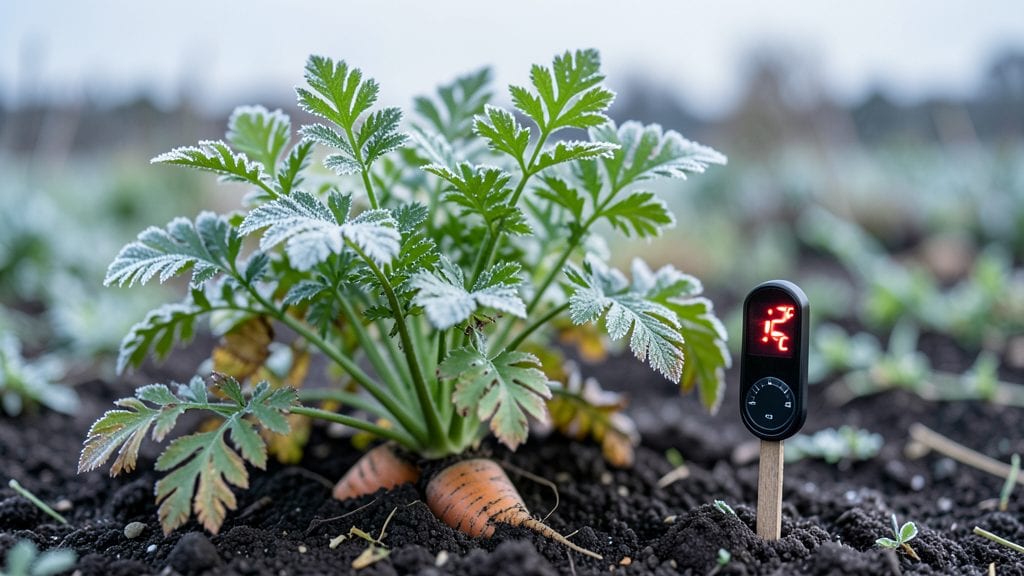
Carrot seeds can survive frost down to 20°F (-6°C), but they’ll die in prolonged freezes below 15°F (-9°C). Planting directly in cold soil (40-50°F) and using mulch helps, though germination slows significantly in freezing conditions.
Carrot seeds have a surprisingly tough exterior that shields their delicate embryos from brief cold snaps, thanks to natural antifreeze proteins in their seed coats. 🌱 However, once temperatures drop below 15°F (-9°C) for more than a few hours, cellular damage becomes irreversible.
The key to success in chilly climates lies in planting depth—seeds buried just ½ inch deep stay warmer than surface-planted ones, while varieties like 'Nantes' handle cold better than others.
For gardeners in Zone 5 or colder, I recommend starting seeds indoors in late winter and transplanting hardened seedlings after the last frost. A thick layer of straw mulch (at least 3 inches) acts like a blanket, insulating seeds while still allowing moisture to penetrate.
If you’re pushing the limits, consider using mini hoop tunnels or cold frames to create a microclimate that mimics spring conditions.
💡 In This Article
- Carrot Seed Cold Hardiness Explained
- Frost-Proof Carrot Planting Strategies
Carrot seed cold hardiness explained
Carrot seeds owe their frost tolerance to a combination of biological adaptations. The seed coat contains natural antifreeze proteins that prevent ice crystal formation in the embryo, much like how some fish survive in Arctic waters.
These proteins bind to water molecules, lowering the freezing point by about 3-5°F—a critical buffer during light frosts. The seed's moisture content also plays a role; properly dried seeds (around 5-8% moisture) enter a metabolic dormancy state, slowing cellular activity to near-halt until conditions improve.
Here's where it gets interesting: the seed's hardiness varies by variety. For example, 'Nantes' carrot seeds have thicker seed coats than 'Danvers', giving them a slight edge in cold survival.
Spinach and kale seeds, by comparison, contain even higher concentrations of cryoprotective sugars (like raffinose) that act as natural antifreeze agents—this is why they often germinate in 28-32°F (-2 to 0°C) conditions, outperforming carrots by 8-10°F. The trade-off?
Carrot seeds germinate faster in warm soil, while spinach seeds take longer but handle cold better.
The real vulnerability lies in prolonged exposure to freezing temperatures. Below 15°F (-9°C), the seed coat becomes brittle and cracks, exposing the embryo to irreversible ice damage.
This is why gardeners in Zone 5 often see mixed results—seeds may survive a 20°F (-6°C) dip but fail if temperatures hover near 10°F (-12°C) for more than 12 hours.
The soil's thermal mass matters too: moist, heavy clay holds heat better than sandy loam, creating microclimates where seeds can survive slightly colder nights.
What most people don't realize is how planting depth affects frost survival. Seeds buried just ½ inch deep experience 5-7°F warmer soil temperatures than those on the surface, thanks to heat retention from the earth. This extra insulation can mean the difference between germination and failure during early spring frosts.
Compare this to radish seeds, which thrive at ½ inch depth in 40°F (4°C) soil but struggle if planted deeper than ¼ inch—carrots are the opposite in this regard.
Moisture management is another critical factor. While seeds need moisture to germinate, excess water in freezing soil creates ice lenses that physically damage seed coats. The ideal balance is 40-50% soil moisture before planting, with a 2-3 inch mulch layer to prevent evaporation and temperature swings.
This approach mimics natural woodland conditions where carrot seeds evolved—moist but well-drained forest floors that rarely freeze solid.
For visual learners, imagine this: A carrot seed's survival in frost is like a frog in winter—it doesn't freeze solid because its body produces natural antifreeze compounds. But if the pond freezes completely for weeks, even the hardiest frog won't survive.
That's your carrot seed's limit: brief cold snaps are manageable, but prolonged freezes are fatal. 🌱